Tribal Tour of Nagaland
This tour serves as an apt introduction to Nagaland, bringing forth authentic travel encounters with the locals and enabling the traveler to witness elements of life in the Naga Hills.
Nagaland is one of Northeast India's most fascinating states, and only recently has the outside world been able to explore more of this land. A land of sixteen indigenous tribes, Nagaland is commonly called as 'the Land of Festivals'. The topography of the region consists of remote mountains that are a sub-part of the Himalayan Range. Due to decades of hostility until recent years and under-development, the infrastructure in the state is quite basic, but this has only helped preserve Nagaland's pristine beauty and culture. Though Christianity is a major part of the tribal lifestyles, the tribes retain much of their original and ancient customs and cultures which can be experienced during village walks and also on the occasion of indigenous festivals. Most of the rural folk were once fierce tribal warriors and headhunters, but are now peaceful farmers. The tribes live sustainable lives and utilize minimal resources. Villagers are friendly and welcome their guests with great hospitality.
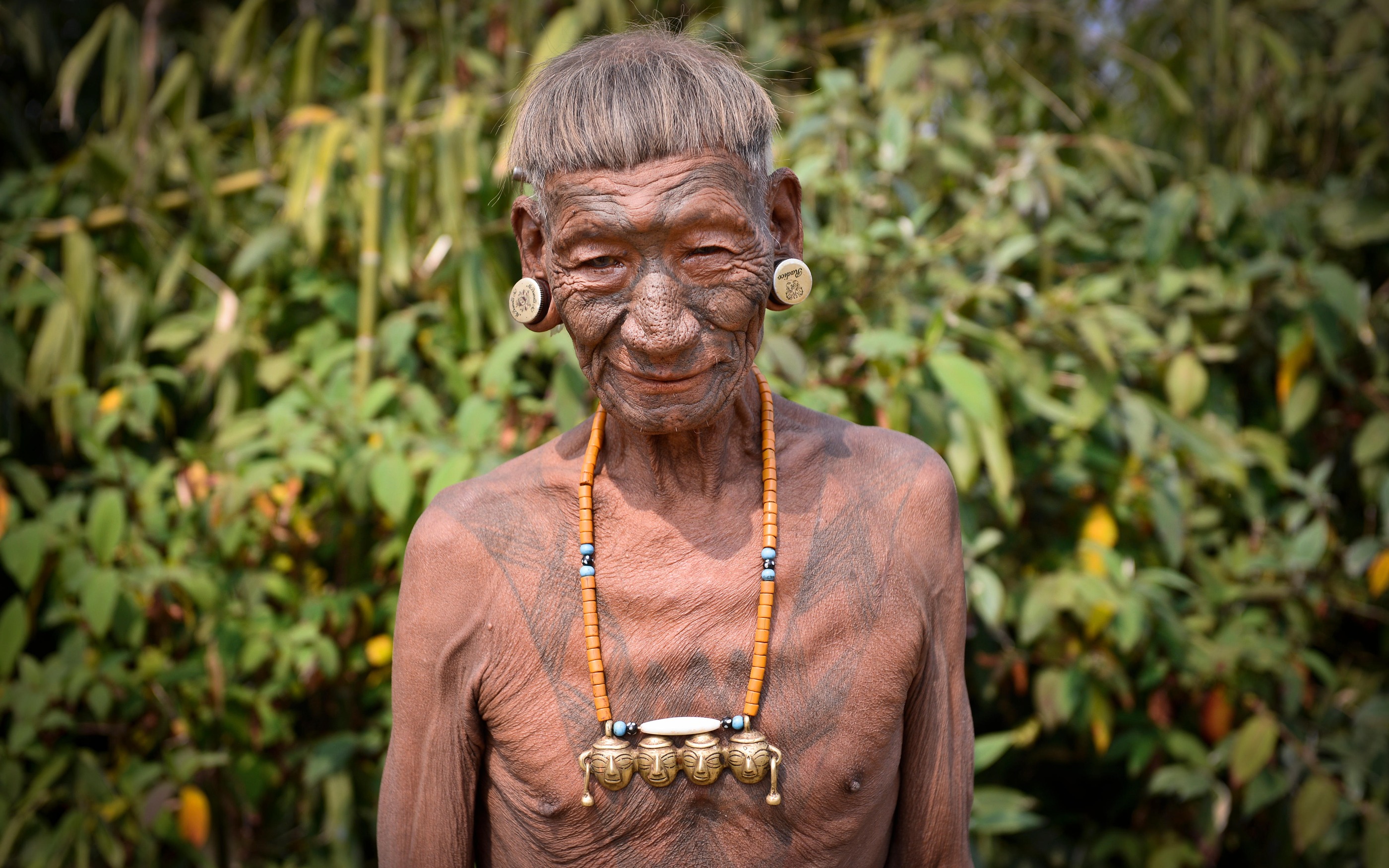
This tour will take you across the hilly terrain of Nagaland from the Patkai hills in the east to the base of Japfu Peak in the west. You will visit the verdant hills of remote Mon district where the once headhunters Konyak Tribe live in all their pride and fierceness. In Mon you will find many traditional elements such as elderly tattooed warriors walking the streets and gathering at the village chief's court to smoke opium. You will visit various villages where people still dwell in traditional long houses and get to learn more about Konyak Naga culture. A visit to Lungwa is also included.
Lungwa is a village that is half in Burma and half in India. Moving along, you will visit the intellectual and cultural capital of Nagaland – Mokokchung, where the fascinating Ao Tribe lives. You will get to see surrounding villages, and old churches and visit Ao traditional houses, Morung dormitories, and log drums, thus learning more about them. The tour will end in the Angami-dominated regions of the capital Kohima and nearby villages such as Khonoma and Dzuleke where you will be staying in homestays with local families, visiting villages and historic memorials of World War II.
At a Glance

Tribal Cultures
Get to meet the fascinating tribes of Nagaland such as the Konyak and the Ao peoples.

Verdant Hills
A scenic road trip through the lush ranges of the Patkai and Naga Hills.
Village Walks
Go on charming and leisurely village walks. Engage in slow-paced cultural travel.

Day by Day

Dibrugarh
Arrive at Dibrugarh, an important tea center in Assam. Check in at a standard city hotel or a comfortable clubhouse with modern amenities. The rest of the day will be free to explore the local markets in the town, see the nearby tea gardens, visit a shrine of Hinayana Buddhism or go on a stroll along the banks of the Brahmaputra River and enjoy the sunset.


Dibrugarh - Mon
After breakfast, drive to Mon (7hrs) in the Patkai hills of northern Nagaland. Mon can be considered as one of the most remote regions of eastern India and is the home of the fierce headhunting Konyak Tribe, known for their tattooed faces, wood carving, and gun-making skills. The Konyaks can be easily distinguished from the other Naga tribes due to tattoos earned from their head-hunting expeditions, a practice banned as late as the 1960s. Your stay will be in a family-run guesthouse with basic amenities.

Longwa — the village on the border
After breakfast, travel to the remote eastern corner of India to Lungwa Village (2hrs), half of which falls in Myanmar. Visit the home of the Angh (village chieftain), whose house interestingly is divided by the border. Interact with the chief and other Konyak families to learn about their rich history and culture. See their local crafts and war trophies collected in the Morungs (dormitories), where young children were taught their traditions. The Morungs also have large log drums which are used to alert the villagers. One can also purchase beautiful tribal ornaments and interesting metal craft souvenirs from the villagers. Explore the countryside, and take a walk in their farms where they practice Jhum cultivation. Later, return to Mon by evening.

Mon
Visit a few nearby Konyak villages such as Hongphoi, Wangla, and Old Mon. A good opportunity to observe the Konyak lifestyle, tribal arts, and crafts. In Hongphoi, it is easy to see village elders with tattooed warrior faces. Visit the houses of the chiefs, which are decorated with skulls of wild buffaloes and other hunted animals. Elderly villagers with tattoos can be sometimes seen gathering at the chief’s house or making bamboo crafts in the Morungs nearby. An old-world charm exists as the long-houses are very traditional, constructed in ancient Konyak way of using palm leaf roofing. Many villagers still continue to live their old traditional lifestyle.

Mon - Mokokchung
Travel southwards to the town of Mokokchung (9hrs), which is one of the most important towns in Nagaland. Historically, Mokokchung was the first town to be established by the British in the Naga Hills. It is home to the Ao tribes, who are famous for their arts and folklore. After a long journey, rest in a clean and comfortable hotel for your night's stay.

Mokokchung
After breakfast, explore the nearby villages of the Ao tribe. Visit Mopungchuket, famous for the story of Jina and Etiben, the Ao version of Romeo and Juliet. See the beautifully carved time pillar, which depicts the chronological history of the Ao tribe along with tales of legends, battles, and migrations. Visit the sacred lake nearby where rituals and sacrifices were performed before the wars. See old churches, log drums, Dzukis (dormitories), and the cultural museum in the village which has an interesting collection of artifacts and rare photographs. Also visit the nearby village of Aliba, where the Aos became the first Naga tribe to be converted into Christianity by the Baptist Missionaries in 1872. After lunch, explore the villages of Longkhum and Ungma, which is the largest village of the Ao people. One can still see elderly villagers with traditional tattoos. Enjoy the panoramic view of the Doyang dam from the Longkhum village.

Mokokchung to Kohima
Drive south to Kohima (7 hours), the capital of Nagaland and the heart of Angami country — the Angami are one of the largest tribal communities in the state. The road runs through terraced hillsides and Angami villages, with stops along the way. Check in at The Heritage, the old District Commissioner’s bungalow above the town, and take the evening at leisure.


Kohima
A full day of sightseeing in Kohima, much of it around the Battle of Kohima in 1944. Visit the World War II Memorial located at the center of Kohima, which was once the battle site. It is the main landmark of the town and commemorates the sacrifices of the British and Indian troops resisting the Japanese invasion. Visit the Reconciliation Cathedral, which is noted for its beautiful architecture, mural paintings, and view of the town from the Aradura hilltop. The State Museum is another interesting attraction that exhibits a rare collection of tribal artifacts of different tribes which portrays their history and indigenous culture. Also visit Kisama Heritage Village, the venue of the famous Hornbill Festival. It also showcases Naga tribal architecture and has a World War II Museum within the complex. If time permits, visit Bara Basti, which was once the old settlement of Kohima.

Kohima - Dzuleke
After breakfast, proceed to Dzuleke (3hrs), another village of the Angami tribe. Dzuleke is a remote idyllic village surrounded by pine forests and streams. A community-based ecotourism project exists here and is run by the village council. On the way, visit Khonoma village, well known for its initiatives of forest conservation and a ban on hunting. One can also see the historic spots where the natives fought against the British colonists. The rest of the day will be free at leisure to enjoy amidst the greenery of the Naga Hills. Your stay will be in a village homestay with basic amenities.

Dzuleke - Benreu - Dzuleke
Go on a day trip to Benreu (2hrs), the village of the Zeliangrong tribe. It is located at an elevation of 1900m at the base of Mt. Pauna where travelers can go on short hikes. Explore the village and visit the Morung (dormitory) at Benreu, considered as one of the oldest structures in Nagaland. Zeliangrong tribe comprises of three clans namely Zeme, Liangme, and Rongme. Few Zeliangrong tribesmen continue to practice their old beliefs and animist religion. One can also try the interesting bitter honey of Benreu, which is harvested from the hive of the Teliane bee and has medicinal properties. Return to Dzuleke by dusk.


Dzuleke - Dimapur
Leave early morning to Dimapur Airport (4 hours) for departure in the afternoon. End of tour.

Your Retreats
When you travel with us, we make sure that you stay in the best available accommodations in the places you visit, especially since many areas in Northeast India are remote and do not have many options to stay. These properties are highly reviewed by our team of experts and are aesthetic in nature when possible. Our itineraries are flexible, highly customizable, and you can always choose a different property depending on budget and style.

Konyak Tea Retreat
The Konyak Tea Retreat is located at Shiyong Village near to Mon town. Run by an enthusiastic Konyak lady who is passionate about responsible tourism and her culture, the highlight of the property is its location midst verdant hills, villages, tea estates and fruit orchards. Rooms have a unique decor, are spacious and fairly modern.
“Tea gardens on one side, Konyak villages on the other.”

Whispering Winds
Whispering Winds, located in the verdant hills of Mokokchung, is a cozy minimalistic guesthouse run by enthusiastic locals. Rooms are clean and with standard amenities. There are good views of the hills from the hotel and rooms.
“Small, quiet, and very welcome after a nine-hour drive.”

The Heritage
The charming and boutique The Heritage in Kohima was earlier the District Commissioner's bungalow. An old property styled in typical early 20th century raj-era with high-ceilinged woody rooms and airy verandas with armchairs for relaxing and soaking the views. Accommodation is fairly standard.
“Old bones, warm rooms, and a veranda built for sitting.”

Dzuleke Village Homestay
Dzuleke is a pretty village of the Angami people midst lush hill scenery. The people of the village have been known for their consideration towards the jungles and conservation measures, and have lately started a responsible homestay project in the village where guests are allotted alternatively to different families and can get a chance to experience first-hand the Naga hospitality and way of life.
“Pine forest, a stream, and almost nobody else.”
Why Travel With Greener Pastures?


Curated Experiences
Our itineraries are one of a kind, curated from our own personal travel experiences, from choosing the best logistically correct routes to the most interesting stay options.
Native Guides
Our tour guides are native to the region, and bring you an insider view into the life and culture of Northeast India, sharing with you authentic local experiences and fostering friendships.
Experts in Tours
When traveling with Greener Pastures, you can be assured that you are in the hands of experts who are knowledgeable and passionate about the region. Expect hassle-free, easy-going, and insightful travel.
“By choosing us, we share together a pledge towards responsible tourism, and share a belief that travel has the power to positively transform local livelihoods, cultures and environment.”
— The Greener Pastures Promise
Read the travel guide to Nagaland for the seasons, the festivals and what else is worth the detour.


Travel news from Northeast India.
Stories from the field, our upcoming experiences, and other travel related news from Northeast India.